Do you know what the most frustrating thing for a content creator is?
When you consistently publish articles online, build pages, make connections, and send email outreach pitches, yet still a competitor with honestly much thinner and weaker content somehow manages to rank above you.
And you can't just figure out why?
But what if I tell you a part of the answer often sits in a number you never checked?
Every site carries an authority score that determines how well your pages can rank in search results, and rivals with a higher one start the race ahead of you.
Don't worry, you too can see that number in under a minute, and you can raise it with habits that cost time more than money.
All you need to do is, just keep on scrolling this guide, and by the end you will surely have a clear idea of how to check your domain authority and raise it step by step.
So, keep reading.
What Is Domain Authority?
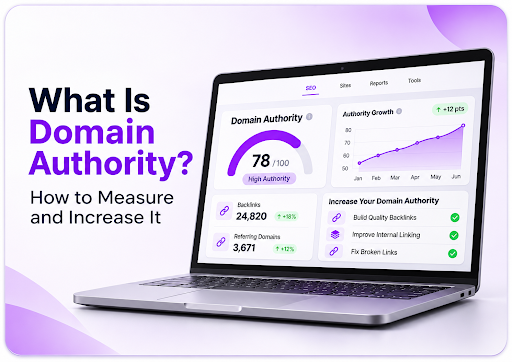
Domain authority (DA) is a score from 1 to 100 that predicts how well a website can rank in search results.
In simpler words, a higher authority score means your website has a better chance of securing a top ranking on SERPs. And vice versa.
It is mostly measured through the amount and quantity of backlinks a website is receiving.
Generally, a domain authority of 50-60 is considered good.
But the important point is, these scores are only estimates. Google does not use DA to rank pages. Therefore, this is just a way to compare your site with others, not a guarantee of traffic.
How to Measure Domain Authority
How do you check the domain authority of your website? Here is a simple and comprehensive step-by-step guide you can follow:
- Open the domain authority checker in your browser.
- Enter your domain. Type the root domain only, such as yoursite.com, with no page path.
- Within seconds, the tool will calculate and display the DA of your website.
- Check the details. Look at the number of linking domains and the spam score. These show why your DA is where it is.
The tip here is, along with checking the domain authority of your domain, also run a check of your competitors. Enter two or three sites that rank for your target keywords. This tells you whether your score is high or low for your niche.
5 Tips to Increase Domain Authority
Here are some practical and effective tips that professionals trust to steadily improve the domain authority of your website.
1. Create content other sites want to cite
The amount of quality backlinks your website receives depends on how helpful your content is.
Original research, detailed guides, free tools, and clear data are some of the most common types of content that earn backlinks.
And honestly, creating your content for citations isn't as hard as it seems. For instance, if you want to create original data, just run a small survey, collect audience opinion and publish the results with charts.
If your data actually demonstrates a clear trend, other writers will ultimately turn to you whenever they need statistics. Not only that, but Google too will rank you on top of SERPs, because it sees you as a reliable source whenever someone needs current statistics.
The only tip is to make sure to update the statistical data and charts every 6 months to ensure they stay accurate.
2. Do outreach and guest posting
Let’s be honest, waiting for new backlinks might take ages. Especially if your website is new, you won't be able to earn backlinks that easily.
Therefore, rather than wasting your time waiting for others to link to you, it's better that you ask for backlinks yourself.
Find blogs in your niche that accept guest posts and pitch a specific topic, not a vague offer. Write for their readers first, and include one link back to a relevant page on your site.
Moreover, you can also contact writers who have covered topics you’ve published on.
Keep the email short: name the article you read and explain what your page adds.
The notable point here is: don't pitch any blog blindly. You see, however many blogs accept guest posts, check their audience and choose only the ones that actually fit your niche and can improve your site’s authority.
3. Clean up bad links
No doubt the backlinks are important for improving the Domain Authority of any website, but remember, it's the quality of your backlinks that makes a difference, not the quantity.
If, on one hand, you have received 100 backlinks from a spammy site, it won't help you rank better; rather, it will hurt the authority you already have.
On the other hand, a single backlink from an authoritative site is enough to instantly boost the authority of your website.
Therefore, when searching for backlinks, don't accept every offer you receive; instead, open Google Search Console, go to Links, and review who links to you. Look for obvious spam, like casino or pharmacy sites with no connection to yours. Ask the site owner to remove the link.
If that fails, use Google’s disavow tool to ignore those links manually.
4. Fix broken links and reclaim lost ones
Broken pages waste the links pointing at them. And this honestly is one of the most common reasons why some websites fail to rank despite having a lot of backlinks.
So, what you need to do is crawl your site with a tool like Screaming Frog or Ahrefs’ Site Audit.
Find pages that return a 404 error but still have backlinks, and 301-redirect them to the closest matching page.
You can also find dead links on other sites that point to topics you cover.
Email the owner and suggest your page as the replacement. Or else, you can also offer a better resource of your own. But don't ever leave a broken link behind.
5. Strengthen your internal linking
Internal links don't have any direct impact on the DA score of your website. Yet they still serve as a booster when it comes to improving the Domain Authority.
Confused how?
Because they spread the authority you earn across your site.
For instance, suppose your homepage received the most backlinks; you can link it to your best pages and the pages you want to rank, and in no time those pages will gain more authority.
The tip here is, when linking internally, make sure to use descriptive anchor text like “email marketing checklist,” not the generic ones like “click here.” This makes the topic of the link clear to Google. And it enhances the relevance of the content, ensuring the right pages rank for the right keywords.
Also, when you publish something new, link to it from older posts.
Final Words
Domain authority will never pay your bills. But traffic, leads, and sales do. So, you can think of the domain authority as a thermometer; it tells you about the health and the well-being of your website, but can't ensure a single visitor or sale. And a notable point here is that, as a content creator, you have to understand that building authority takes time. Most sites see no movement for months, then a few good links shift everything. Therefore, stay consistent and patient. If you face a lag, don't panic, keep on working on your content and links, and one day you will surely see your score rise.