“How long will this take?” is usually the second question a client asks, right after “how much will this cost?” And it is a fair one. You are trying to plan a launch, coordinate marketing, or hit a deadline tied to a funding round or a seasonal push, and a vague answer does not help you plan anything.
The honest answer is that a web development timeline depends heavily on what kind of site you are building, but that does not mean it cannot be estimated with real accuracy. At Ovitech, we quote timelines on nearly every proposal we send, and the businesses that plan around realistic numbers, instead of guessing, avoid a lot of frustration later.
This guide breaks down what actually affects build website time, what a realistic website launch timeline looks like for different project types, and how to avoid the delays that catch most people off guard.
What Determines a Web Development Timeline?
Before looking at specific numbers, it helps to understand what actually drives the timeline up or down. A five-page brochure site and a custom ecommerce platform are not on the same clock, and neither are two five-page sites if one client responds to emails in an hour and the other takes two weeks.
Here are the core factors that shape any custom development timeline:
- Scope and page count. More pages, more templates, and more unique layouts all add build time.
- Design complexity. A site built from an existing theme moves faster than one requiring fully custom visual design.
- Functionality requirements. Booking systems, membership areas, custom integrations, and multi-language support all extend the timeline.
- Content readiness. Sites where the client provides final copy and images upfront move dramatically faster than sites where content is still being written mid-project.
- Revision rounds. Every round of feedback and changes adds days, sometimes weeks, especially when feedback comes in slowly or changes direction partway through.
- Third-party dependencies. Waiting on a payment gateway approval, a domain transfer, or a client’s marketing team to approve final copy can stall a project that is otherwise ready to launch.
Most delays in a website project duration come from client-side bottlenecks, not development speed. This is worth knowing upfront, because it changes how you plan your own side of the process.
Average Web Development Timeline by Project Type
Numbers help more than vague ranges. Here is what a realistic web development timeline looks like across common project types, based on projects we have delivered directly.
Simple Brochure or Landing Page Website
A basic site with five to eight pages, built on WordPress or a similar platform with an existing theme, typically takes two to four weeks. This assumes content is ready and revisions stay focused.
Custom Business Website
A site with custom design, ten to twenty pages, and moderate functionality like contact forms, blog integration, and basic SEO setup usually takes four to eight weeks.
Ecommerce Store (Shopify or WooCommerce)
A standard online store with product catalog setup, payment integration, and a customized theme generally takes six to ten weeks. Stores with a large product catalog requiring manual data entry, or custom checkout flows, can extend past this.
Custom Web Application or Complex Platform
Projects involving custom backend development, user accounts, dashboards, or integrations with multiple third-party systems typically take twelve weeks or longer, sometimes stretching to six months for genuinely complex platforms.
Website Redesign
Redesigning an existing site usually falls in the four- to eight-week range, similar to a custom business build, though it can move faster if the existing content and structure require only moderate changes rather than a full rebuild.
Web Development Timeline Comparison Table
Seeing these side by side makes planning easier, especially when you are budgeting time around a launch date or marketing campaign.
| Project Type | Typical Timeline | Key Factors That Extend It |
|---|---|---|
| Landing page (1 to 3 pages) | 1 to 2 weeks | Custom animations, copywriting delays |
| Brochure website (5 to 8 pages) | 2 to 4 weeks | Custom design, slow content delivery |
| Custom business website (10 to 20 pages) | 4 to 8 weeks | Complex functionality, multiple revision rounds |
| Ecommerce store | 6 to 10 weeks | Large product catalog, custom checkout logic |
| Website redesign | 4 to 8 weeks | Content migration, SEO preservation work |
| Custom web application | 12+ weeks | Backend complexity, third-party integrations |
| Multi-language or multi-region site | 8 to 14 weeks | Translation delays, region-specific content |
These figures assume reasonably responsive communication on the client side. Add one to three weeks to any of these ranges if feedback or content delivery tends to lag.
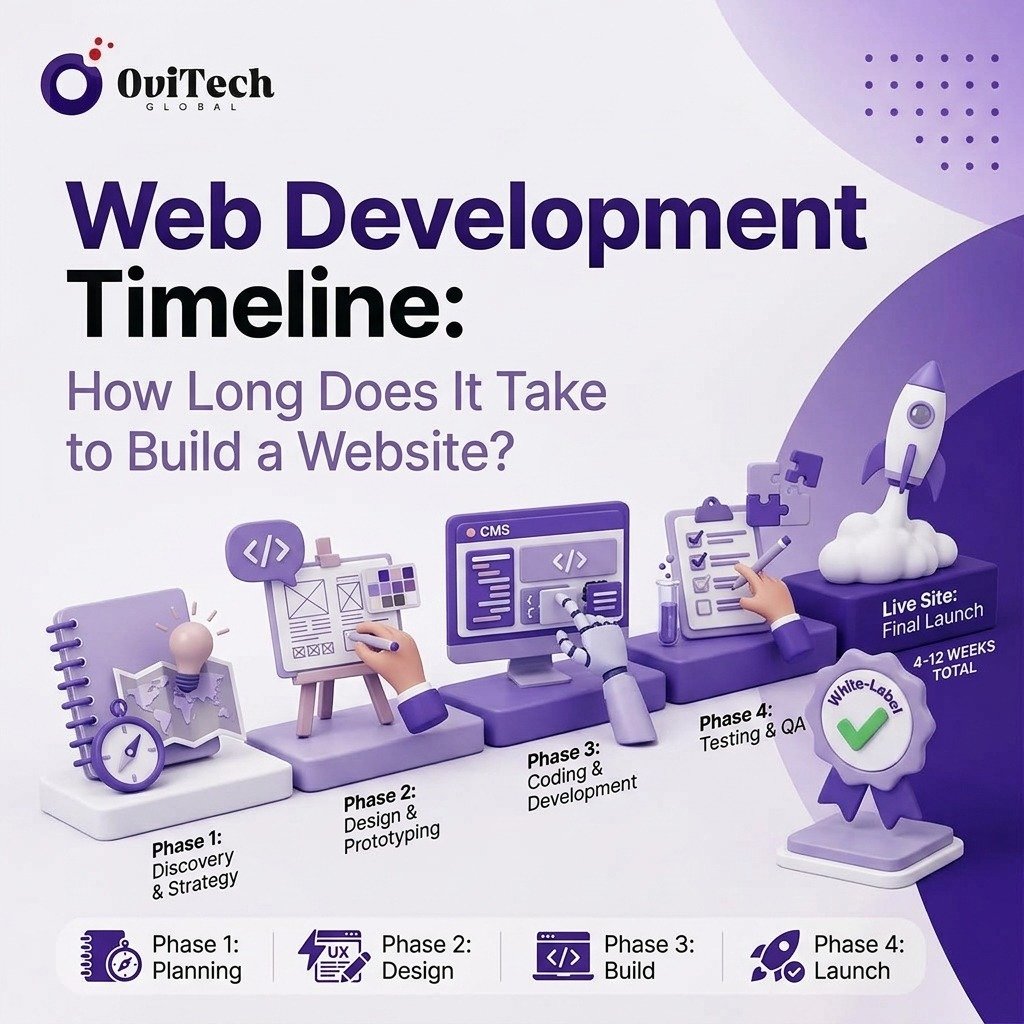
The Website Development Process, Stage by Stage
Understanding where the time actually goes helps set realistic expectations for a website launch timeline.
Discovery and Planning (3 to 7 Days)
This stage covers defining the scope, gathering requirements, and agreeing on the sitemap and core functionality. Rushing this stage almost always causes delays later, since unclear requirements lead to scope changes mid-build.
Design (1 to 3 Weeks)
Wireframes and visual design happen here. Custom design work takes longer than working from an existing template or theme, but it produces a site that looks genuinely distinct rather than one that resembles dozens of other sites built on the same theme.
Development (2 to 8 Weeks, Depending on Complexity)
The actual build happens in this stage. Simple sites move through this quickly. Custom functionality, integrations, and complex layouts extend it considerably.
Content Integration (Overlaps with Development)
Final copy, images, and product data get added to the built pages. This stage moves fastest when content is prepared in advance rather than written during the build.
Testing and QA (3 to 7 Days)
Every page gets checked across devices and browsers, forms get tested, and any bugs get fixed before launch. Skipping or rushing this stage is a common cause of post-launch issues that damage first impressions.
Launch and Post-Launch Support (1 to 3 Days, Plus Ongoing)
The site goes live, DNS and hosting get finalized, and the team monitors for any immediate issues. Many agencies, including Ovitech, include a short post-launch support window to catch anything that surfaces once real traffic starts hitting the site.
What Actually Causes Websites to Miss Their Timeline
Most delayed projects are not delayed because of development speed. They are delayed because of predictable, avoidable bottlenecks. Here is what to watch for.
Content that is not ready. This is, by a wide margin, the most common cause of delay. A development team can build the structure of a site quickly, but cannot finish pages without final copy, images, and product information.
Scope creep during the build. Adding new pages, features, or design changes partway through the project pushes back every stage that follows. This is not necessarily a bad thing if the added value justifies it, but it needs to be planned for rather than treated as a surprise.
Slow feedback cycles. A revision round that takes two weeks to review instead of two days adds real time to the overall custom development timeline, even though the actual work involved might only be a few hours.
Waiting on third-party approvals. Payment gateway verifications, domain transfers, and app store or plugin approvals are outside a development team’s direct control and can stall an otherwise ready project.
Unclear decision-making on the client side. Projects with multiple stakeholders who need to individually approve design or content decisions tend to move slower than projects with one clear decision-maker.
Real-World Example: Planning Around a Launch Date
A client came to Ovitech needing a new ecommerce store live before a specific trade show, giving us roughly seven weeks from kickoff to launch. Given the standard six- to ten-week range for a store of that size, this was tight but achievable, provided content was ready early.
We structured the project around that constraint directly: content and product data were locked in during week one, design moved in parallel with early development work, and revision rounds were capped to 48 hour turnarounds on both sides. The store launched three days before the event, with the tight timeline holding specifically because content readiness and fast feedback were treated as priorities from day one, not afterthoughts.
This is a useful pattern to notice. A web development timeline is rarely fixed purely by technical build speed. It is just as often shaped by how prepared and responsive the client side of the project is.
How to Keep Your Website Project on Schedule
If you want your website build time to stay as close to the original estimate as possible, a few habits make a real difference.
- Prepare your content, copy, and images before development starts, not during it.
- Assign one clear decision-maker to approve design and content choices.
- Respond to revision requests within a set turnaround window, ideally 48 to 72 hours.
- Lock your scope early and treat mid-project additions as a separate, clearly discussed decision.
- Confirm any third-party accounts (payment processors, domains, APIs) are set up before development reaches the stage that depends on them.
None of these guarantee a project moves faster than its baseline estimate, but they consistently prevent the avoidable delays that push a website launch timeline well past where it should have landed.
FAQs About Web Development Timelines
Q1: Can a website really be built in one week?
A very simple landing page with minimal content and no custom functionality can sometimes be completed in about a week. A full business website or ecommerce store realistically cannot, regardless of how fast a development team works, because design, content integration, and testing each require dedicated time to do properly.
Q2: Why do some agencies quote much shorter timelines than others for the same project?
This usually comes down to either a difference in scope interpretation, the use of pre-built templates versus custom design, or, in some cases, an unrealistic quote meant to win the project that later slips once work begins. Ask specifically what is included in the quoted timeline, and whether it assumes content will be ready on day one.
Q3: Does a website redesign take less time than building a new site from scratch?
Generally yes, since existing content, structure, and branding provide a starting point rather than a blank page. However, a redesign involving a full rebuild of the design and a significant restructuring of content can take just as long as a new build, particularly if SEO preservation work is involved.
Q4: How much of the website project duration is actually spent on development versus other stages?
Development typically accounts for roughly 40 to 50 percent of the total timeline on most projects. The rest is split between discovery, design, content integration, testing, and revisions. This is why projects with unclear requirements or slow content delivery often take longer than the development work alone would suggest.
Q5: What is the fastest way to shorten my website’s timeline?
Have your content, images, and any necessary account setups (payment processors, domain access) ready before the project starts, and commit to fast turnaround times on feedback and approvals. These two factors influence the timeline more than almost anything on the development side.
Q6: Do ecommerce sites always take longer than regular business websites?
In most cases, yes, because ecommerce sites involve additional layers like payment integration, product catalog setup, shipping configuration, and often more thorough testing due to the transactional nature of the site. A store with a large product catalog requiring manual entry will also add meaningful time beyond the base build.
Q7: Should I expect delays if my project involves custom design instead of a template?
Custom design generally adds one to three weeks compared to working from an existing theme or template, since every layout and visual element is created from scratch rather than adapted from something pre-built. This tradeoff often produces a more distinct final result, but it does extend the custom development timeline.
Q8: What happens if my project goes over the original timeline?
Most reputable agencies will communicate clearly if a delay is likely, explain the cause, and provide a revised estimate rather than staying silent until the original deadline passes. If delays are consistently caused by factors on the agency’s side rather than content or approval delays from the client, that is a fair thing to raise directly with them.