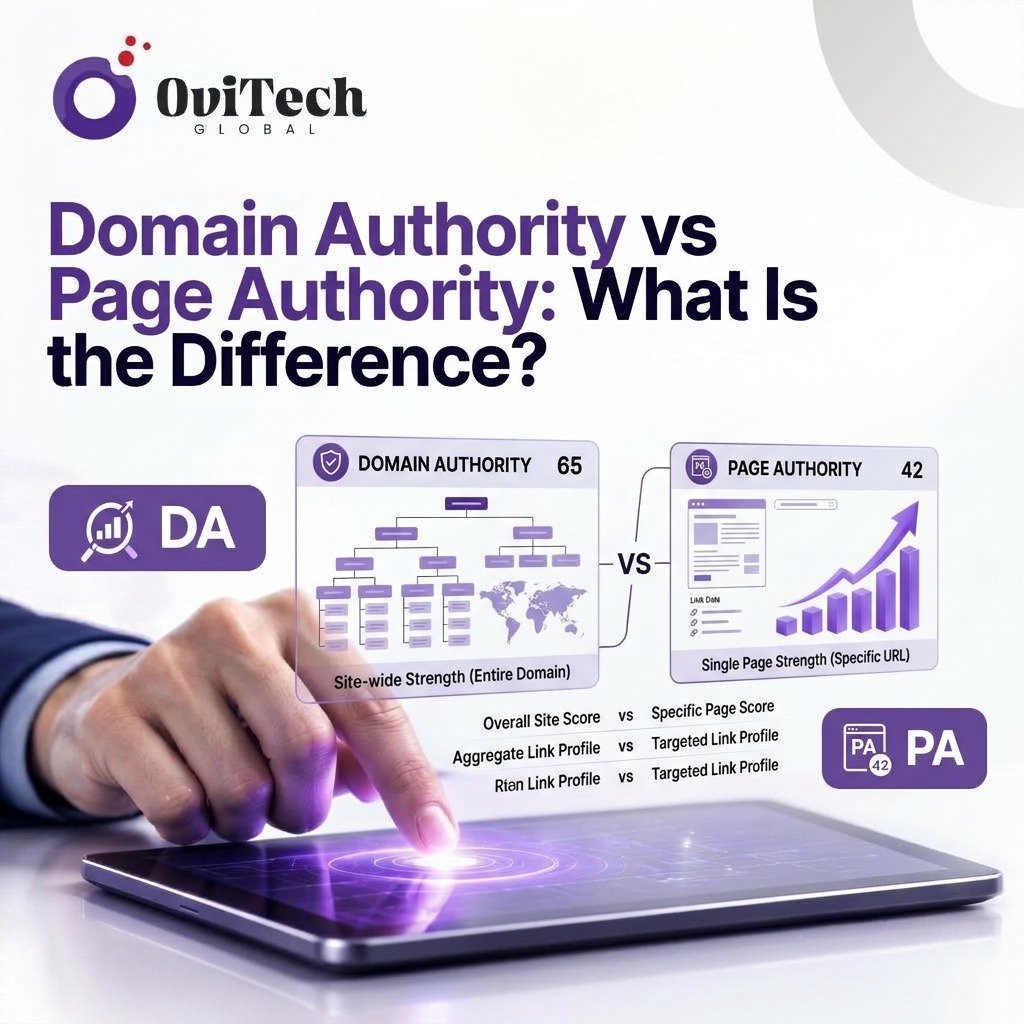
You run a link checker, and two numbers come back. One is for your whole site. The other is for the single page you typed in. They do not match, and now you are wondering which one is the real score.
Both are real. They answer different questions. At Ovitech, we see people mix them up in client reports all the time, and that mix-up leads to bad decisions, like chasing links to a page that doesn't need them or judging a whole site by one weak URL.
This guide explains domain authority vs page authority in plain words, shows where each one helps, and gives you a simple way to use both without wasting time.
What Is the Difference Between Domain Authority and Page Authority?
Domain authority (DA) predicts how well an entire website can rank. Page authority (PA) predicts how well one specific URL can rank. Both come from Moz, both use a scale from 1 to 100, and both rely mostly on backlinks.
In short, DA scores the whole house, and PA scores a single room.
A site can have a modest DA and still hold one page with a high PA, because that page earned strong links. The reverse also happens: a big, respected site can publish a new page that starts with a low PA.
What Is Domain Authority?
Domain authority is a Moz score that estimates how likely a whole domain is to rank in search results. It looks at the quality and number of unique websites linking to you, and it covers every page on the domain and its subdomains.
DA is the best-known website authority score, and you should use it when you want to judge the overall strength of a site. It helps with:
- Comparing your site against competitors
- Judging whether a site is worth approaching for a link
- Choosing keywords your site has a fair chance of winning
- Tracking long-term link building progress
You can read more in our full guide on what domain authority is and why it matters.
What Is Page Authority?
Page authority is a Moz score that estimates how likely one specific page is to rank. It looks at the links pointing to that exact URL, plus how strong those links are.
Use PA when you care about a single page. It helps with:
- Finding which of your pages already have link strength
- Deciding which pages deserve more internal links
- Picking which competitor pages are easiest to beat
- Spotting pages worth updating because they already attract links
PA is often the more practical number for daily work, because rankings happen at the page level. Google ranks URLs, not domains.
Domain Authority vs Page Authority: Side by Side
This table shows the main differences at a glance.
| Factor | Domain Authority (DA) | Page Authority (PA) |
|---|---|---|
| What it scores | An entire website | One single URL |
| Created by | Moz | Moz |
| Scale | 1 to 100 | 1 to 100 |
| Main input | Links to the whole domain | Links to that specific page |
| Changes speed | Slow, moves over months | Can shift faster after new links |
| Best for | Judging overall site strength | Judging one page’s ranking chance |
| Common use | Competitor and link prospect checks | Page-level optimization and content updates |
| Google uses it? | No | No |
Neither score is a Google ranking factor. Both are outside estimates of link strength, which Google does consider in its own way.
How Do DA and PA Work Together?
The DA vs PA question is really about scope, and the two scores connect without moving in lockstep. A strong domain lends some weight to its new pages through internal links and general trust. A weak domain gives new pages little help.
Think of it like a shop in a busy shopping center. The center brings foot traffic, which helps every shop. But a shop with great word of mouth does better still.
Here is how that plays out in practice:
- High DA, low PA. A new blog post on a strong site. It may rank quickly for easy terms, but it needs links and internal support for harder ones.
- Low DA, high PA. A single guide that earned lots of links on a small site. It can outrank bigger sites for its topic.
- High DA, high PA. The best position. Strong site, strong page.
- Low DA, low PA. A new site or page. It needs links and patience.
Which SEO Metrics Should You Check First?
Start with the question you are trying to answer, then pick the metric.
- “Can my site compete in this niche?” Check DA and compare it with the top-ranking sites.
- “Can this page beat that page?” Check PA for both URLs.
- “Is this site worth a backlink?” Check DA, then check relevance and real traffic.
- “Which of my pages should get more links?” Check PA to find pages that already have momentum.
Moz is only one provider of SEO metrics, so keep the DA vs PA comparison inside one tool. Ahrefs offers Domain Rating and URL Rating, and Semrush offers an Authority Score. These website authority scores use different data, so the numbers will not match across tools. Pick one tool and track it consistently. You can test your own numbers with our free DA PA checker.
DA vs PA: Real World Example
A home services company came to Ovitech wondering why a competitor with a lower DA kept outranking them for “emergency boiler repair.” Their DA was 34. The competitor’s DA was 22.
We checked PA. The competitor’s service page had a PA of 41 because a local news site and two trade blogs linked straight to it. Our client’s matching page had a PA of 14 and almost no links.
We improved the page with clearer content, added internal links from the homepage and related pages, and earned a few relevant local links. After a few months, the page moved up. The lesson was simple: a strong domain does not rescue a weak page. (This example is illustrative and not a documented client case.)
How to Improve DA and PA the Right Way
There are no safe shortcuts. Both scores rise when you earn good links and build useful pages.
To Raise Domain Authority
- Publish helpful content that other sites want to cite.
- Earn editorial links through PR and content marketing.
- Remove or disavow clearly spammy links.
To Raise Page Authority
- Add internal links to the page from related, high-traffic pages.
- Update the content so it deserves links.
- Promote the page to people who write about the topic.
Want to find weak spots on both levels? Run a free SEO audit and review which pages carry the most link value.
Common Mistakes With Authority Scores
- Treating the score as a goal. Rankings, traffic, and leads matter more than any number.
- Comparing scores across different tools. Moz, Ahrefs, and Semrush each use their own formulas.
- Judging a link only by DA. A relevant link from a modest site can beat an irrelevant link from a giant one.
- Ignoring PA when planning links. Sending links to a page that has no chance of ranking wastes effort.
If you are unsure which pages to prioritize, Contact Us, and we will look at your numbers with you.
FAQs About Domain Authority vs Page Authority
Q1: Which matters more, DA or PA?
It depends on your goal. DA matters more for judging overall site strength and competition. PA matters more when you want to rank one particular page. Most SEO work uses both: DA to choose your battles and PA to win them.
Q2: Are DA and PA Google ranking factors?
No. Both are Moz metrics, and Google does not use them. They estimate link strength, which is something Google does evaluate in its own way. Use them for comparison, not as levers to pull.
Q3: Can a page have a higher PA than its domain’s DA?
Yes. If a single page earns strong links, its PA can exceed the site’s overall DA. This often happens with popular guides, tools, or research pages on smaller websites.
Q4: Does a high DA help new pages rank?
It helps somewhat, because new pages inherit some trust through internal links and the site’s reputation. But a new page still needs good content and links of its own to rank for competitive terms.
Q5: How often do DA and PA change?
Both can change whenever Moz updates its link index. PA can move faster than DA after a page gains or loses links. Track trends over months, not days.
Q6: What is a good PA score?
It depends on the pages you compete against. Compare your page’s PA with the top results for your target keyword. If you sit close to them, you have a real chance. If you are far below, focus on links and content first.
Q7: Do other tools have equivalents of DA and PA?
Yes. Ahrefs uses Domain Rating and URL Rating. Semrush uses an Authority Score. They measure similar ideas with different data, so avoid mixing numbers between tools.
Q8: Should I check DA and PA before buying a link or guest post?
Check them, but do not stop there. Also look at relevance, real organic traffic, and whether the site links out to low-quality pages. A decent score on a spammy site is still a poor choice.
Ready to turn these numbers into better rankings? Contact us for a clear plan based on your competitors and your goals.
Written for business owners and marketers who want to read authority scores correctly. More guides live on our blog.